The core problem
AI accelerates individual tasks, but in larger organizations it creates new friction, blurred responsibilities, and governance risk unless it is explicitly controlled.
Executive Overview
KI Project Organization describes how large software companies can use AI roles not only productively, but also in a way that remains governable, auditable, and resilient across teams. At its core are clear responsibilities, traceable handovers, and an operating model that combines delivery speed with governance. This becomes especially valuable in regulated environments and critical infrastructure, where changes, approvals, and rationales must remain traceable across the full product lifecycle.
Management Summary
AI accelerates individual tasks, but in larger organizations it creates new friction, blurred responsibilities, and governance risk unless it is explicitly controlled.
A ticket-based, role-oriented operating model in which AI work moves through defined states, artifacts, reviews, and approvals.
Less handover loss, greater transparency, more stable delivery chains, and a stronger basis for scaling across products and teams.
Approvals, responsibilities, and open issues remain visible. That reduces risk in regulated, security-sensitive, or release-critical delivery chains.
In certification-related or critical systems, documentation duties and change evidence are not added afterwards, but are carried within the process itself.
The model does not depend on a single chat or agent. It depends on reproducible role logic that can be extended organizationally.
The approach connects to existing PM, QA, review, and architecture processes instead of undermining them through shadow AI workflows.
Executive View
Many AI initiatives produce impressive isolated results today, but they fail in larger organizations for one simple reason: they are not truly governable. As soon as specialized roles, reviews, approvals, and documentation duties come into play, gaps appear between speed and reliability.
KI Project Organization addresses exactly this tension. Instead of treating AI as a loose side activity, it embeds AI into an operating model that makes ownership, progress state, quality logic, and decision paths visible.
This becomes especially relevant in development for critical infrastructure. Where BSI-like requirements, auditability, approval evidence, and the traceability of changes in certified systems matter, a fast AI answer is not enough. What is needed is a rule-bound development process that links documentation, review, decisions, and delivery artifacts end to end.
The result is not a tool pitch, but an operating approach for coordinated AI work: less implicit knowledge, fewer shadow processes, and a much stronger basis for scale, governance, and dependable delivery.
Business Impact
Enterprise Readiness
Instead of merely completing tasks faster, the model defines how AI work is embedded into existing delivery, review, and approval chains. That is what separates experimental automation from enterprise-ready use.
The model prevents AI answers from silently becoming “truth.” Every role has a clear mission, defined artifacts, and visible boundaries.
Findings, reviews, rework, and approvals are treated as part of the system. This reduces the risk of fast results flowing unchecked into production or management decisions.
New teams, reviewers, or stakeholders can not only see the results, but also understand how those results came to exist. That is critical for scaling in larger organizations.
Large software companies need not only innovation, but also repeatability, traceability, and control. That is the bridge KI Project Organization is designed to build.
In KRITIS, BSI-like, or certification-related environments, changes must remain traceable across the full product lifecycle. This is exactly where the model shows its strength: changes are not only generated, but made permanently processable together with ownership, rationale, review, approval, and documentation.
Deep Dive
For leaders who want to understand how ownership, decisions, and execution remain clearly separated.
For PMO, delivery, and operations stakeholders focused on status logic, approvals, and execution flow.
For architecture, platform, and governance stakeholders focused on structure, artifacts, and technical integration.
For stakeholders who want to understand why guardrails do not slow scalable AI work down, but stabilize it.
For a lighter, more dialog-based entry into the target model, its tensions, and the learning it creates.
The precise source rule behind the model. More relevant for operational and reviewing roles than for a first executive entry point.
Project visualization
The AI poster condenses the idea of the role-based organization visually: specialized agents do not work loosely side by side, but together through explicit handovers, status, and artifacts.
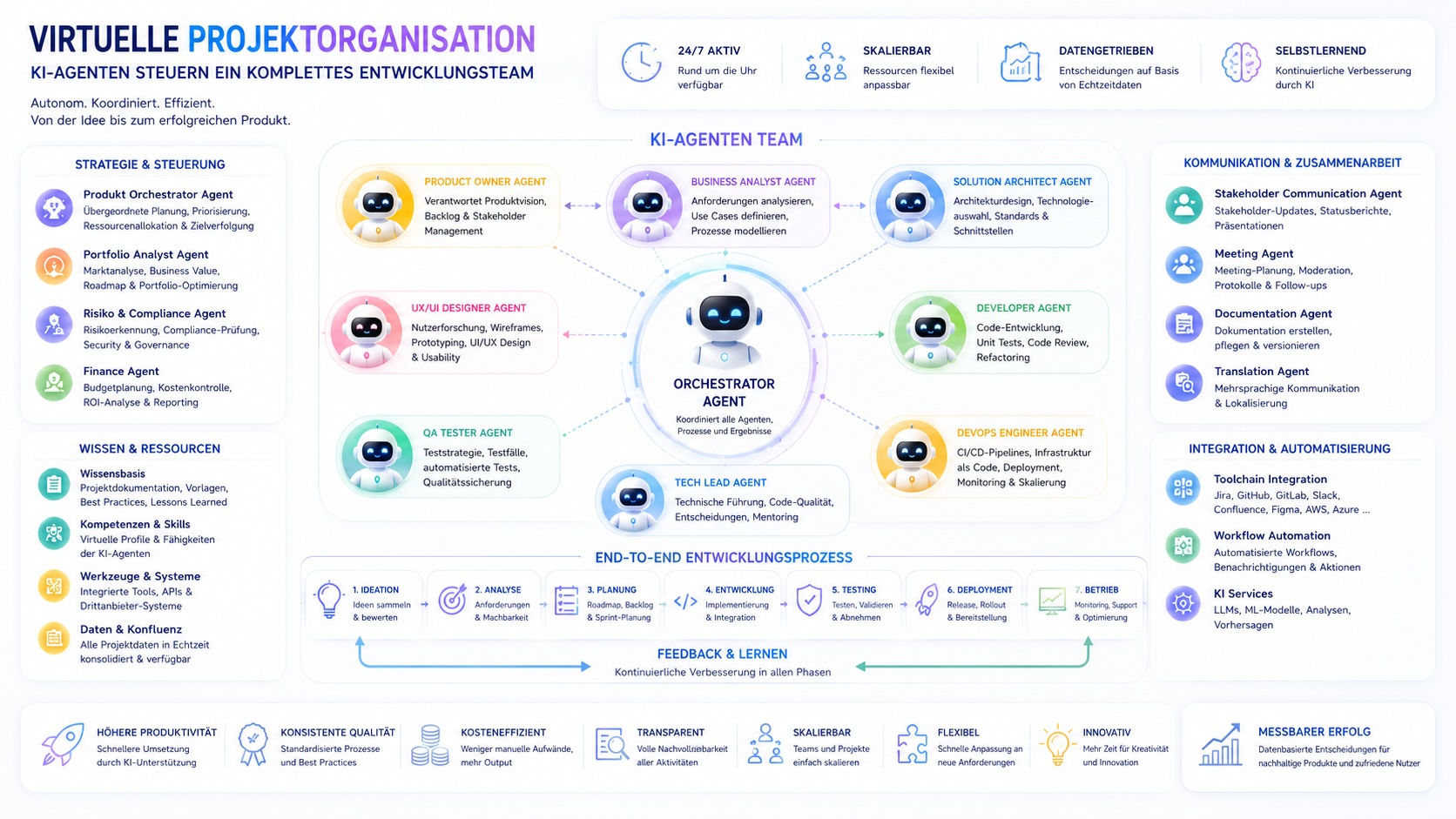 Click to enlarge